
In Central Europe, the word Gerbeaud doesn’t need any additional explanation. It could refer to the cake, Gerbeaud Slices, or to Gerbeaud Cukrászda, the equally famous “kaffehaus” in Budapest. Cukrászda is loosely translated as “confectionary” but it describes a very European type of establishment where people go to have a cup of coffee or tea, and a slice of a fine cake. A coffee house/sweet house. There is a recognisable word, “cukor” (sugar), in the root of the word cukrászda (Zucker, zucchero, záchari, zahăr, šećer .. in other languages, all of them derived from the Turkish words şeker).

Gerbeaud cake (Zserbó in Hungarian) is one of my favourite deserts. I make it every now and then. It’s not complicated but it does take some time. It’s a very fine cake, although unusual since the dough is made with yeast, not a common feature in lush, luxurious deserts. The dough stays thin, however, thanks to a high proportion of sugar, which prevents it from rising. The other main ingredients include ground walnuts, apricot glaze and chocolate topping.
Like most famous European cakes, Gerbeaud has its own story. It was named after Emil Gerbeaud, a Swiss confectioner who in 1884 took over the business from the original owner of the café, Henrik Kugler, inventing the cake and renaming the café. Emil Gerbeaud raised the already high standards in cake making, and made the café more opulent. Apparently, the current Gerbeaud Cukrászda sports some of the marble-topped tables that Emil had delivered from Paris in 1900.

The recipe itself hasn’t changed a lot since then, but the café had more turbulent history. At one point during the WWI it was turned to a stable. After the 1948 nationalization, the family emigrated to Brazil. Gerbeaud Cukrászda was renamed after the square where was (still is) located until then current owner revived it in 1984 by selling the name for two million dollars — and Gerbeaud Cukrászda was reborn.
The café (the address is Vörösmarty Square 7, in downtown Budapest, if some happy occasion ever takes you there) offers many fabulous cakes and deserts, including two of the shiniest stars when it comes to Hungarian art of patisserie: Gerbeaud Slices and Esterhazy Torte.
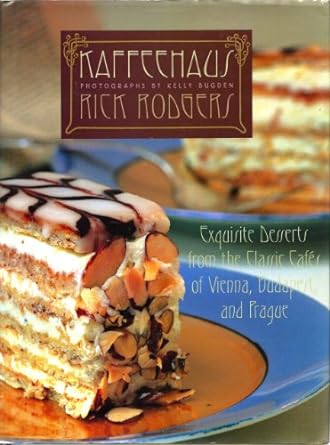
I use the recipe from the book I call my cake Bible — Kaffehaus by Rick Rodgers, which brings to life the best of the best: the Central European pastry tradition. I’ll leave the story of Esterhazy Torte for another time (it’s on the cover of the book!). It appears that the recipes from this particular book are under copyright, so I found a similar one for Gerbeaud Slices, if it ever strikes your fancy. I would just mention that I make one extra step with apricot jam – I bring it to boil, add some rum aroma to it, then I push it through a mesh to get rid of the stringy bits and pieces of apricots. In other words, I turn apricot jam into a smooth and spreadable apricot glaze. The other modification is the chocolate icing. I make it with 4 ounces of dark chocolate, 1/3 cup sugar, 1/4 cup water and a blob of unsalted butter (1 TBSP). To make it shiny, I cook chocolate, water and sugar until they reach 220 F (3-4 minutes), remove it from heat and add butter, stirring until it melts, then pour it, warm and still liquid, over the cake.
Why did I decide to write this “sweet story”? Every now and then my posts (which are not food related) attract the occasional food blogger, and that was the inspiration for this piece — I just want to see how it’s going to fare. The other reason is that I am a relatively skilled amateur pâtissier, so I was thinking it would be nice to share my creations and experiences. I’m not always inspired to talk about books, reading and writing. If I try hard, I can make a connection, however: Gerbeaud Slices are mentioned in one of my books. But it’s not necessary: every fine cake has a story behind it and perhaps it’s worth retelling it.
Lastly, it doesn’t happen often that my cake looks better than the photo in the book, like my most recent Gerbeaud Slices.
What is the best cake/desert you’ve ever tasted?


 JF Kaufmann, Author
I haven’t heard of Gerbeaud before. Your slices look beautiful! The best dessert I’ve ever had was baklava made by a woman from Russia. So flaky, so sweet.
LikeLiked by 1 person
I make excellent Turkish baklava (the one that is moist, not dry like some others). It’s probably one of the easiest deserts to make and because of that it’s even easier to ruin it. There are only a few steps, but each is crucial. Next time I make it, I’ll post the recipe and all the steps, so you can make your own baklava. 🌸
LikeLiked by 1 person
Those slices of your exquisite-looking cake are making my mouth water. I’ve never heard of Gerbeaud or Esterhazy Torte before, but I’d sure like to try them. My current favourite cake is a chocolate lava cake with a side of ice cream.
LikeLiked by 1 person
I’ve never tried chocolate lava cake. I’ll add it to my “to do” list. 🌸
LikeLiked by 1 person
That Gerbeaud cake you made looks so good!!
LikeLiked by 1 person
Thank you! 🌸
LikeLiked by 1 person
You’re welcome!
LikeLike
Your cake does look wonderful! I have a dim memory of buying a Sachertorte for a dinner party once, and a slice of Gâteau St. Honoré after a lunch another time. I don’t have the skills to create such things, but fortunately others do!
LikeLiked by 1 person
Thank you! Sachertorte is famous, although I find it too dense and dry. My husband loves it, though, so I make it every now and then.
Funny, I can make fine cakes, but I’m unable to make decent cookies. Go figure. 🤷♀️
LikeLiked by 1 person