
During the 13th century, the Mongols tried to invade Japan not once, but twice, in 1274 and 1281.
After the conquest of China in 1230 and Korea in the following year, Kublai Khan turned his attention to Japan, which was only a hundred miles away from his borders. Japan had every reason to be fearful; for several years, Kublai-Khan had been sending messages to the Emperor of Japan demanding that he submit to the Mongols or face invasion. They never reached the Emperor–the shogun, the real power behind the throne, made sure of that.
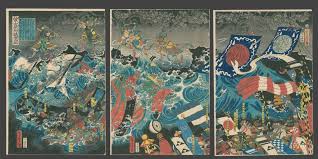
Furious and offended by the Emperor’s silence, the Mongols set to work on building an enormous fleet of warships and recruited a huge army made of Chinese and Korean soldiers.
In the autumn of 1274, the Mongols launched their first invasion of Japan, known as the Battle of Bun’ei. Between 500 to 900 vessels and about 40,000 warriors reached the shores of Hakata Bay. Outnumbered and outmaneuvered, the Japanese began to withdraw.
Suspecting the Japanese would return with reinforcements, the Mongols retreated to their ships. That night, the typhoon — the divine wind, or kamikaze (神風) — struck the anchored ships in Hakata Bay. (I hope the word in Japanese is printed correctly). By daybreak, only a few vessels remained. The rest were destroyed, taking the lives of thousands of soldiers with them.
Neither the Mongols nor the Japanese thought it was the end of the war. More determined than ever to conquer Japan, the Mongols started rebuilding their fleet, and the Japanese built two-meter-high walls along Hakata Bay to protect themselves.
Seven years later, the Mongols returned in force. They had a fleet of staggering 4,400 ships and an estimated 70,000 to 140,000 soldiers. Part of the army set out from Korea; another sailed from southern China, finally uniting near Hakata Bay in August 1281. The fiercely defended walls prevented them from coming close to any landing beaches. The fleet didn’t have a choice but to stay afloat for months, getting depleted of their supplies as they searched for an area to land.
On August 15, 1281 (when I started writing this post, it was also August 15, but I was unaware of this small coincidence), the Mongols had had enough–they were about to launch their assault on the much smaller Japanese forces.

And then, it happened again: a massive typhoon hit (and as I learned on one of the YouTube documentaries, it wasn’t even the season for typhoons), wrecking the Mongol fleet. Contemporary Japanese accounts indicate that over 4,000 ships were destroyed and 80 percent of the soldiers either drowned or were killed by Japanese defenders. The second invasion became one of the largest and most disastrous attempts at a naval invasion in history. (I cannot, of course, vouch for the numbers of ships and casualties; I didn’t check the reliable historical sources).
The Mongols never attacked Japan again.
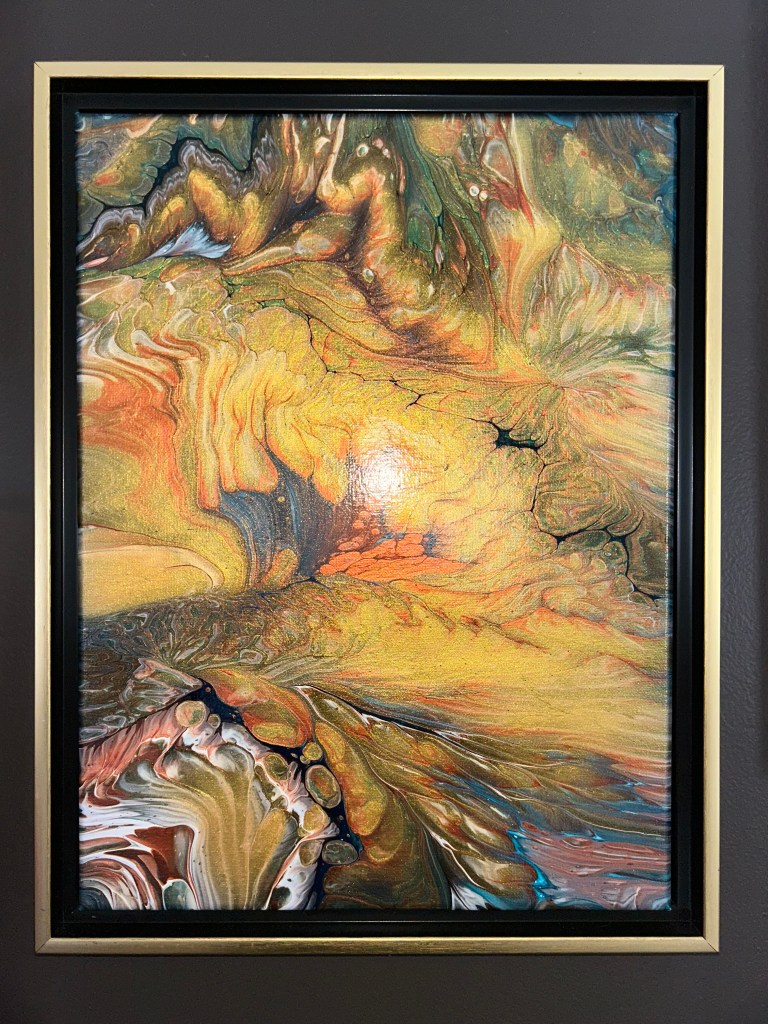
Now, the reason for this post is the connection between a series of books that I love and a painting that I made. I wrote about the dragon, Temeraiere, the main character in the series of books by Naomi Novik. He is a celestial dragon, the rarest and most powerful in the dragonworld, and he’s capable of making the divine wind. Novik marvelously used the history and legend of the divine wind. (Not only that I love her books, but she also sparked my curiosity about some historical events, including the two Mongolian attempts to invade Japan. The David and Goliath type of stories never leave me indifferent, maybe because the history of my people–and we are small–is full of them.)
Two years ago, I made this painting and I called it “Divine Wind”, not after the historical events (I wouldn’t dare to try that), but as a tribute to my favourite dragon. This is a perfect example of the “backward inspiration” that is so unique to acrylic pouring: I just picked the colours, the canvas size, and chose which technique I was going to use without any intentions.
When the painting was done, I saw Temeraire’s ferocious breath, the divine wind.


 JF Kaufmann, Author
That is a marvellous painting! Interesting to know about its associations.
LikeLiked by 1 person
Thank you so much, Audrey! It’s one of my favourite pieces – because of those connections.
LikeLiked by 1 person
I love your painting!
LikeLiked by 2 people
Thank you so much!
LikeLiked by 1 person
You’re welcome!
LikeLiked by 1 person
First of all, I love your painting, JF! Second, what a bizarre, double-typhoon story. Either the Mongolians had terrible luck or the Divine part of the divine wind was protecting Japan.
LikeLiked by 1 person
Thank you for the compliment!
It’s a fascinating story. Incredible luck or a miracle? Probably both.
LikeLiked by 1 person