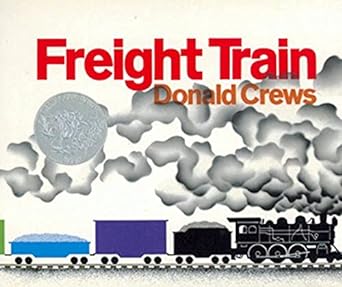
A few weeks ago, I was waiting beside the railway crossing near my work for it to pass: a mile-long Trans-Canadian train, with three engines at the beginning, two at the end, and more than a hundred cars in between. You may hear of a popular children’s book, Freight Train by Donald Crews. “A train runs across this truck./Red caboose at the back/Orange tank card next/Yellow hopper car…” and so on. Waiting for trains to drive by always brings this story to my mind and I keep repeating it silently. I’ve delivered hundreds of storytimes and often used this book for the little guys so I know it by heart, as with many others. Quite a few of my storytime favourites featured trains — you can’t go wrong with the things that go.

Photo by Louis Paulin on Unsplash
That day, it took a good ten to twelve minutes for the boom gate to lift up again, but that’s nothing unusual. Trains go through the heart of the city, the endless freight compositions compiled of red-and-black engines and cars, although much less colorful than in Crew’s book. They frequently create traffic delays with their slow advance. There is a rail yard in a part of Calgary called Bonnybrook, but not an official station in the city for them to stop and rest.
Trains are one of the interesting constants in my life. I was born in a city that had and still has a railway station. There are two words for trains and stations in my native language, which is Serbo-Croatian (once one language and linguistically still one language since we perfectly understand each other, and have almost identical grammar and vocabulary with some minor differences, but forced and renamed into three separate ones). In Croatian it’s vlak for train, and kolodvor for the station. In Serbian and Bosnian, they are voz and stanica.
These subtle linguistic variations, however, symbolize my life in two (or three) diverse historical and cultural circles geographically divided by the River Sava.
Vlak and kolodvor have been connected to my early childhood and my school holidays spent in my home city, Osijek, south of the Hungarian border in the north of Croatia. The station was only a few minutes from my father’s house: two short blocks down, the first corner right, straight again, turn right again. Before I saw the station, I could smell its unique, memory-triggering scent — a dear mixture of truck steel, wooden railway ties, and the heavy but not unpleasant whiff of grease. I could hear the station’s breathing: an engine would carefully speed up leaving the station; the other one would slow down, arriving with a heavy sigh and a loud hiss. A small, local train with one or two to three passenger cars, which resembled a street car more that a train, would chug in or out with its lighter and cheerful sound. This train, a diesel motor railbus called with the same word, šinobus, in all three languages, connected the big villages and small towns thoughtfully built over centuries throughout the Pannonian flats. I would hear a ding-dong, followed by a voice from a loudspeaker, or the invisible and omnipresent station master blowing his whistle, allowing yet another train to leave the station.
Only then would the station itself come into view: a long, two-storey building with plenty of windows, a spacious waiting room in its belly, with a ceramic-tiled floor, cash registers along the walls, wooden benches, and hanging flower pots sporting robust and colorful geraniums. Once it looked neat and clean, now it’s tired and neglected. Once you could reach every part of Europe from there, today you can travel to only a few other cities and towns. Like many other public places, the station dates back to Austro-Hungarian times, when this corner of Central Europe, among many others, was under the rule of the K u K Monarchie.*
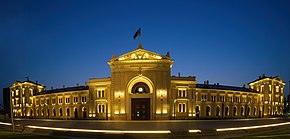
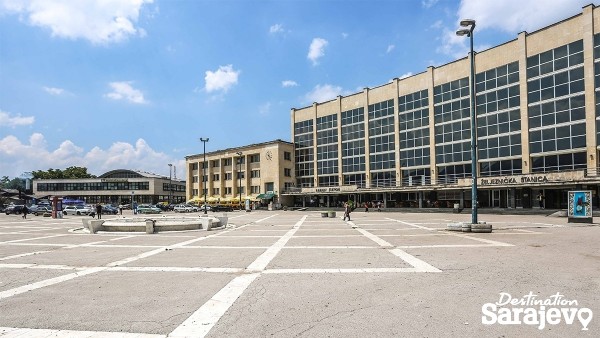
So, at the end of my school break, I would leave my lovely hometown from the kolodvor with a vlak. Only about a hundred kilometers from there, these two words would change, and I would arrive with the voz at the main stanica of my beloved adopted city of Sarajevo, with its strong Ottoman influence (although the the railway station itself was envisioned and constructed during the several decades long K. u. K occupation in 1882, after the Ottomans had left).
The twice-a-year school holiday return to Osijek would have the opposite perspective: from the East to the West, from the mountains to the flats, from the visions of elegant white mosques with green roofs and tall, slim towers that my eyes and my soul loved so much, to the familiar baroque, rococo and neoclassical architecture of my home city. From one geographical and ethnic milieu to another, from one mentality to another, from voz to vlak, from stanica to kolodvor.
It would not take me long to lean toward the eastern (Bosnian) side although I’d never lost that initial connection to my roots. But my accent quickly changed (it was a natural shift, I was only seven). I developed the recognizable Bosnian lilt and my vocabulary soaked up new words of Turkish and Arabic origins, replacing the German vocabulary of my childhood. It formed and firmed up my mentality as well. I fell in love with Sarajevo, and its easygoing frame of mind, the generosity of its people, and the incredible Bosnian sense of humor, almost always self-directed. With the nature – the green and silver Bosnia, with her high mountains and cool nights even in the peak of summer, the dry, rocky, hot and fragrant Herzegovina, the rushing rivers of the most incredible emerald colors. With the pre-Christian, Bogomil tradition still imbedded in the soul of the people and land, and with Bosnian rich medieval history. With her multiethnic food, and with her incredible and, back then, peaceful and respectful multiculturality in general. It would be hard not to fall in love with all this.

Just before the war, in that terrifying foreplay of insanity that would soon become reality, something beautiful happened to me – a night train Sarajevo-Belgrade (and back). For a year, from one April to another, every second Thursday, I would hop on a sleeper-train for Belgrade and return with Sunday’s night train to Sarajevo. My arrival in Belgrade was marked by the butterflies in my stomach, by the images of early, misty mornings, by someone who was waiting for me; my departure by a tad of sadness overlaid with the optimistic countdown to the next night trip to Belgrade.

But then the war came and teared up everything quickly and efficiently. I don’t know if that’s for better or worse, but it hurts more, I think. Sometimes, when feelings die slowly, you have time to prepare yourself for the inevitable. Perhaps, but it didn’t happen that way so I can’t really vouch for it. In any case, everything passed and was forgiven and forgotten; only memories of those night travels remind. And my love for Belgrade. I learned then that it was possible to fall in love not only with a person but with a city as well. And that you can fall in and out of love with a person, but not with a city.

Thus Belgrade has unexpectedly become the third most important city in my life before Canada. It was love at first sight, a deep connection that’s impossible to explain. It was far from my West (Osijek) as much as it was from my East (Sarajevo). A cosmopolitan, shiny, buzzing, welcoming city of two million people; charming as much as dangerous during those war years. Wide boulevards, two mighty rivers, handsome architecture, magical Byzantine-style Christian Orthodox churches. True friendships I forged there with people who embraced me when I showed up in my future magazine straight from the besieged Sarajevo only with my handbag — that was my only material possession. They accepted me without a question. They gave me a job and found me a place to live. They scraped up some clothes for me, they shared their food with me, which was, particularly throughout the horrible 1993, an act of incredible humanity and solidarity — often, we were all more hungry than full.
Nothing of this would have happened — good and bad alike — without my frequent train visits to Belgrade just before the war.
Here, trains have different connotations. My most cherished memories are of my youngest son, who was born, I sometimes think, with a genetically encoded passion for trains. When he was three, four, five, six…we used to go every day around noon to wait for a train that passed nearby our apartment building. Normally an energetic and active child, he would sit on a flat stone that was there, fold his tiny hands in his lap, and wait for the signal to change. It would sometimes take forever, but he wouldn’t leave. And then suddenly he would shout, “It’s coming! It’s coming! I told you it would come”. He would jump to his feet and start waiving vigorously even though the train was still far away. As it would approach us, the engineers, God bless their hearts, all of them, without any exception, would lean out of the window, smile and wave back, and often pull the horn to add to the excitement, as if making small boys happy was required in their job description.
This is the significance of trains here: a long, crawling string of engines and cars, the goodhearted engineers, waiting and waiving; the pure joy of my son, his unwavering belief that the train would come, his endless patience. Not small lessons for a such young fella.
The trains that ran through my previous life trucks taught me something important as well: about the joys of all our arrivals and the inevitabilities of all our departures, and perhaps most importantly, that life indeed happens between these two opposite points.
*The phrase Imperial and Royal (German: kaiserlich und königlich, K. u K.), refers to the court/government of the Hapsburgs in a broader historical perspective. Some modern authors restrict its use to the Dual Monarchy of Austria-Hungary from 1867 to 1918. During that period, it indicated that the Habsburg monarch reigned simultaneously as the Kaiser (Emperor of Austria) and as the König (King of Hungary) while the two territories were joined in a real union.


 JF Kaufmann, Author
How interesting! Thanks for sharing these memories.
In Saskatoon, I lived close to the CP freight yard and often heard trains being moved around, sometimes with loud bangs. And quite often the bus I took to work was delayed by having to wait with other traffic for a long train to cross an intersection.
LikeLiked by 1 person
Thank you for your comment, Audrey! There is something fascinating about trains. I used to travel a lot, even as child of 7 or 8, all by myself, back and forth between my dad and mom. Usually my dad or stepdad would ask the conductor to keep an eye on me. It was normal, no one thought that anything bad would happen to me. These were safe and happy times!
LikeLiked by 1 person
This was fascinating, JF! You made me tear-up a little, too. Nostalgia and wisdom and motherhood and trains.
LikeLiked by 1 person
Thanks Priscilla. Nostalgia is getting more and more prominent as I’m getting older.
LikeLiked by 1 person